What to Do When Your Car Breaks Down on a Burnaby Road
A step-by-step guide to staying safe and getting help fast when your vehicle fails on a busy Lower Mainland road.
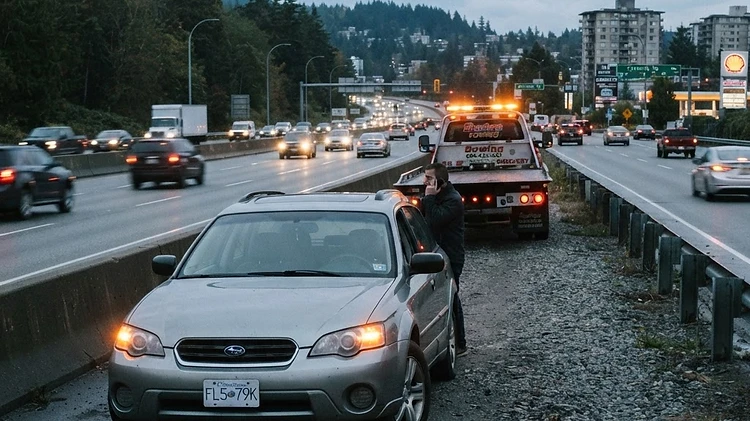
A breakdown almost never happens somewhere convenient. It happens in the middle lane of the Trans-Canada, on the shoulder of the Lougheed, or in a busy Burnaby intersection at 5 PM. What you do in the first five minutes matters far more than what went wrong under the hood — for your safety, and for how quickly you get moving again.
1. Get off the travelled lane if you safely can
The single most dangerous place you can be is stopped in a live lane. If the vehicle still rolls and steers, coast it as far right as you can — a shoulder, a parking lot entrance, a side street, or an exit ramp. Do not attempt a lane change without signalling, and never cross multiple lanes of moving traffic to reach a spot that looks more convenient.
If the car dies in a live lane and cannot be moved, that changes the situation. Turn on your hazards, stay belted with your seatbelt on until you are sure traffic has seen you, and call 911 if you are blocking a highway lane. Then call dispatch with your exact location; a highway recovery needs a properly lit truck, not a friend with a rope.
2. Make yourself visible
Hazard lights are only part of it. At night or in heavy rain, pop the hood or tie something bright to the antenna so other drivers register that your car is not simply waiting at a light. If you carry reflective triangles or flares, set them out several car lengths behind the vehicle — never in an active lane.
Stay inside the vehicle on major highways like Highway 1 or Highway 17. The shoulder is narrow, sight lines are short at highway speed, and standing beside the car puts you in the path of anyone drifting right. Keep your seatbelt on, and keep the interior light on at night so your vehicle is easier to spot.
3. Call dispatch with the details that matter
When you call a tow company, the useful information is short: where you are, what the vehicle is, and whether it rolls, steers and brakes. A cross-street, a highway exit number, or an address on the nearest building all work — latitude and longitude from your phone is even better. Specify if you are in a parkade, underground garage, or on a soft shoulder, because each needs different equipment.
Also tell dispatch whether anyone is vulnerable: a child, a pet, a passenger with mobility issues, or a vehicle sitting in a dangerous spot. Those calls get prioritised, and operators will route the nearest truck rather than waiting for one to come free.
4. Decide: roadside fix or tow
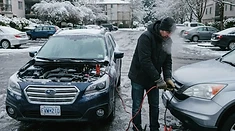
Roughly a third of breakdowns we attend don't need a tow at all. A dead battery, a flat tire, an empty tank or a locked door is usually solved at the roadside in minutes and far cheaper than a hook-up. If you suspect one of those, say so on the call — it changes which equipment gets sent.
If you see smoke, smell burning, notice fluid pouring out, or the steering or braking has changed, stop driving and have the vehicle towed. A short tow costs far less than a destroyed transmission or a cooked engine, and it keeps you out of a moving lane while you weigh your options.
5. Tell them where to take it
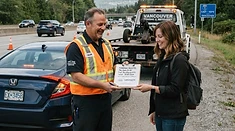
You choose the destination — not the tow operator. Have your preferred repair shop in mind before the truck arrives, or ask for a recommendation near your home rather than the closest lot. It is also worth confirming the total price before you sign anything, including after-hours charges and any winching needed to get the vehicle out of a ditch or parkade.
If the shop is closed, decide in advance whether the car goes home, to storage, or waits at the shop's lot. Sorting that out on the shoulder while traffic passes you is the worst time to make the call.
- Move right and stop as far from traffic as possible — never stand beside the car on a highway shoulder.
- Hazards on, hood up at night, and stay belted until help or a safe exit appears.
- Give dispatch your exact location, vehicle type, and whether it rolls, steers and brakes.
- Confirm the full price and your chosen destination before the vehicle is hooked up.
Stuck right now?
Alpha Tow dispatches 24/7 across Burnaby, Surrey and the Lower Mainland. A live dispatcher answers every call.
CALL (778) 488-5599