After a Collision: What to Expect From Accident Recovery
A calm walkthrough of the towing and recovery process after a collision in Burnaby or the Lower Mainland.

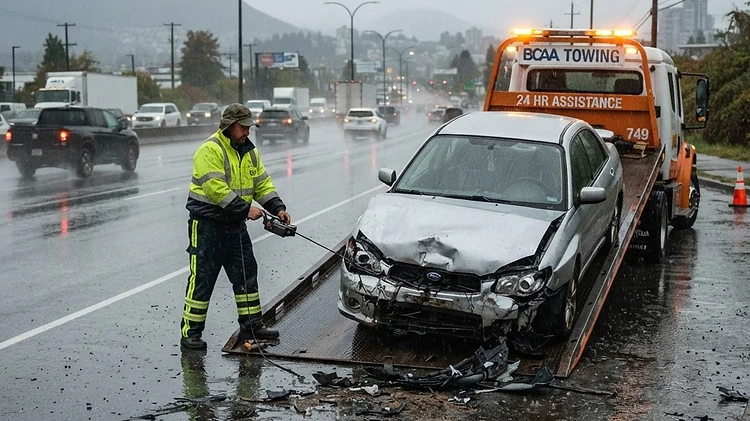
A collision leaves you dealing with three things at once: whether everyone is unhurt, what to tell the other driver and your insurer, and how to get a damaged vehicle off the road. The recovery is usually the simplest of the three — but only if you know what it involves and what decisions are yours to make.
Safety comes before the tow
If anyone is injured, or a vehicle is blocking a live lane, call 911 first. Emergency responders control the scene, and a tow operator will work around them rather than the other way round. Do not stand between the vehicles, and do not move an injured person unless there is immediate danger such as fire.
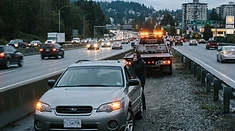
Once the scene is stable, turn on hazards and get yourself and your passengers behind a barrier or well up the shoulder. A damaged vehicle in a live lane is a secondary-collision waiting to happen, especially on Highway 1 or on a bridge approach in the rain.
Why a damaged car can't just be hooked up
A car that has been hit may not roll, may not steer, or may be leaking fluid. Wheels can be jammed at an angle, suspension can be broken, and a dragging bumper can catch the pavement and spin the vehicle. That is why accident recovery is a different job from a routine tow.
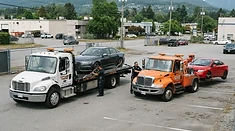
The operator assesses first: which wheels turn, whether the steering is locked, whether there is fuel or coolant on the ground. From there the vehicle is winched onto a flatbed, or lifted on skates and dollies if the wheels will not roll. It takes longer than a normal load, and it is not the moment to rush anyone.
It's your call where the car goes
Nobody can require you to use a particular tow company or a particular storage yard. You choose: your own body shop, an ICBC-accredited repair facility, your home, or secure storage. If you are unsure, ask your insurer which shops are accredited before the truck arrives rather than after.
Be cautious with anyone who arrives unsolicited at a collision scene and pressures you to sign. Say you will arrange your own recovery. If a vehicle is towed without your agreement, you can be charged daily storage on top of the tow, and that adds up fast.
Document everything at the scene
Photograph all vehicles from several angles, the road position, any skid marks, and the other driver's plates and insurance details. Get the name and badge number of any officer who attends. Keep the tow invoice — an itemised bill showing the recovery, distance and any storage is what an insurer will ask for.
Note the time the vehicle was picked up and where it was taken. If your car ends up in storage, storage fees accrue daily, so arrange the move to a shop as soon as your insurer authorises it.
If the vehicle is a write-off
When a vehicle is declared a total loss, the recovery tow is still handled the same way, but the destination often becomes a salvage or ICBC facility. Confirm which one before dispatch — a car delivered to the wrong yard becomes an expensive problem to untangle.
If personal items are still inside, retrieve them at the scene if it is safe, or ask the operator to note them. Once a vehicle is in a salvage yard, getting a phone charger back is not worth the trip.
- Call 911 first if anyone is hurt or a lane is blocked.
- Damaged vehicles are assessed and winched — never simply hooked up and dragged.
- You choose the destination; don't sign with a company that arrives unsolicited.
- Photograph the scene, keep the itemised tow invoice, and confirm the storage yard.
Stuck right now?
Alpha Tow dispatches 24/7 across Burnaby, Surrey and the Lower Mainland. A live dispatcher answers every call.
CALL (778) 488-5599