Motorcycle Towing: Why Your Bike Needs a Flatbed
Two-wheel transport is a different discipline. Here's the right way — and the wrong way — to tow a motorcycle.
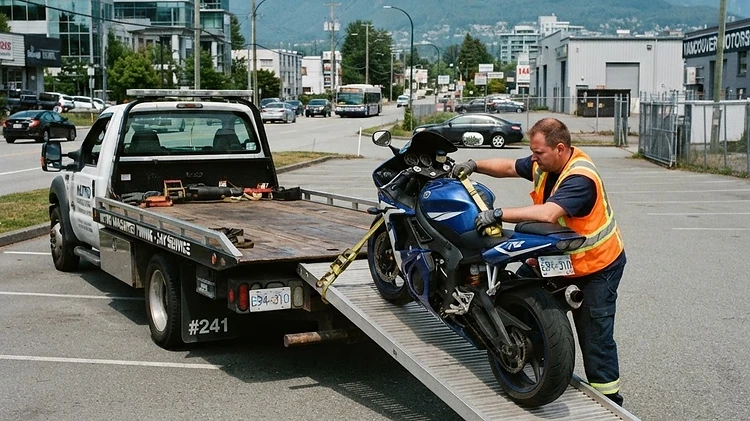
A motorcycle has no safe way to be towed on its own wheels. There is no cab to sit in, no frame to hook under, and a kickstand that folds the moment the bike moves. That leaves one correct method — flat deck, chock and soft straps at the frame — and a set of shortcuts that write off bikes every season.
Why wheel-lift towing doesn't work on a bike
A wheel-lift lifts two wheels and drags the others. On a bike there is nothing to keep it upright once one wheel is off the ground, and the steering will flop the moment the front tire loses contact. Strapping a bike to a wheel-lift yoke risks folding the forks or bending the frame before you reach the end of the block.
The other common shortcut is worse: two people walking a dead bike along while someone tows it slowly, or dragging it with a strap. Neither is safe, and either can turn a mechanical breakdown into a written-off machine.
The correct load: chock, four points, soft straps
The bike rolls or is winched up the flatbed ramp and into a front wheel chock, which holds the front wheel upright. Then it is tied at four points — typically the fork tubes or triple clamp low down at the front, and the frame or passenger peg mounts at the rear — using soft loops around the contact points rather than hooks against paint.
The straps compress the suspension slightly so the bike cannot bounce, but not so hard that fork seals are stressed. Bars are left to move, because strapping the handlebars is a good way to bend them. A bike loaded this way rides hundreds of kilometres without moving a millimetre.
Damaged or dropped bikes need more care
If the bike has gone down, do not assume it can be stood up and rolled. Bent bars, a snapped lever or a cracked case can make it unstable, and a leaking fuel tank is a genuine fire risk. Tell dispatch the bike is down when you call — the operator will bring ramps and extra straps, and will assess before loading.
For a bike that absolutely will not roll, the front end is lifted and the machine is winched up on a skid or dolly. It takes longer, but nothing gets dragged across asphalt.
What to tell dispatch
Give the make, model and rough weight — a cruiser or a touring bike needs different ramp angles and strap points than a 250cc dual-sport. Mention any luggage, panniers, a tall windscreen, or aftermarket bodywork. And confirm the truck carries a motorcycle chock, because not every flatbed does.
If you are transporting a bike for a sale or a track day rather than a breakdown, book it rather than calling it in as an emergency, and you will usually get a better rate and a scheduled window.
- Motorcycles travel on flatbeds, upright in a chock — never on a wheel-lift or dragged.
- Four soft straps at the frame and fork lowers, with slight suspension compression.
- Tell dispatch if the bike is down or won't roll; it needs ramps and extra care.
- Confirm the truck actually carries a motorcycle chock before it arrives.
Stuck right now?
Alpha Tow dispatches 24/7 across Burnaby, Surrey and the Lower Mainland. A live dispatcher answers every call.
CALL (778) 488-5599